
The Western Wall (Kotel) has been excavated by archaeologists since the mid-nineteenth century, but more recent, twenty-first century excavations have opened up the site anew to visitors, who can now experience the parts of the Western Wall beneath the built-up city in several proprietary tours. This guide discusses the various options and what you’ll see on the flagship Great Bridge Tour.
| Region | Address | Time Needed | Accessibility |
|---|---|---|---|
| Central (Jerusalem area) | 📍Western Wall Plaza in Waze/Google Maps (closest Old City gate is the Dung Gate; Jaffa Gate is also a popular entry point) | 2 hours, minimally (for the tour and a brief look around) | The Western Wall Plaza is accessibility to wheelchairs and strollers from the direction of the Dung Gate; the path from the Jaffa Gate has ramps for strollers, probably not adequate for wheelchairs) |
Practical Information
The Western Wall Plaza is free to enter and is open 24 hours a day, 7 days a week. It is accessible by foot only. Nearby parking options including the Karta and Mamilla parking garages near the Jaffa Gate. There is also a light rail station nearby that can be taken from the main Jerusalem train station, and several bus lines that stop nearby as well.
A security screening is required before entering the plaza, and there is security on site. There are two security checkpoints, one larger one from the direction of the Dung Gate and one smaller one from the direction of the Jaffa Gate. There is often a short wait to get through the screening.
Western Wall tunnel tours must be booked in advance for a fee. Tours can be booked easily online here.
There are public bathrooms located in the plaza, on the northern side by the Western Heritage Foundation building.
Approaching the wall, there are men’s and women’s sections, with scarves and kippahs (yarmulkes) available to those who need them.
Table of Contents
The Western Wall Heritage Foundation Tunnel Tours
Tours start in the lobby of the Western Wall Heritage building on the north side of the Western Wall Plaza (to your left as you stand facing the Kotel). The atmosphere is informal and Israeli; you’ll get a wristband from the clerk at the door and then get called over when it’s time for your tour. (We just had to wave our wristbands at the guide.) Tours are available in English as well as Hebrew.
The Great Stone Tour
This tour traverses the path along the Western Wall from south to north, the first route made available to the public. Its highlights include:
- The enormous Western Stone, one of four such stones thought to serve as immovable markers ensuring the rectangular shape of the Temple mount;
- The point closest to Kodesh ha-Kodashim (the Holy of Holies, or inner sanctum of the Jerusalem Temple), assuming that it was located over the Even ha-Shetiya (Foundation Stone) in the present-day Dome of the Rock (there are various traditions and debates about its exact location, with a consensus supporting this location);
- The Struthion (“sparrow”) Pool, a water cistern built by the Hasmoneans (probably) and later used and altered by Herod, today under the Convent of the Sisters of Zion; it is mentioned by Josephus in Bellum Judaicum (The Jewish War) V. 467.
The Great Bridge Tour
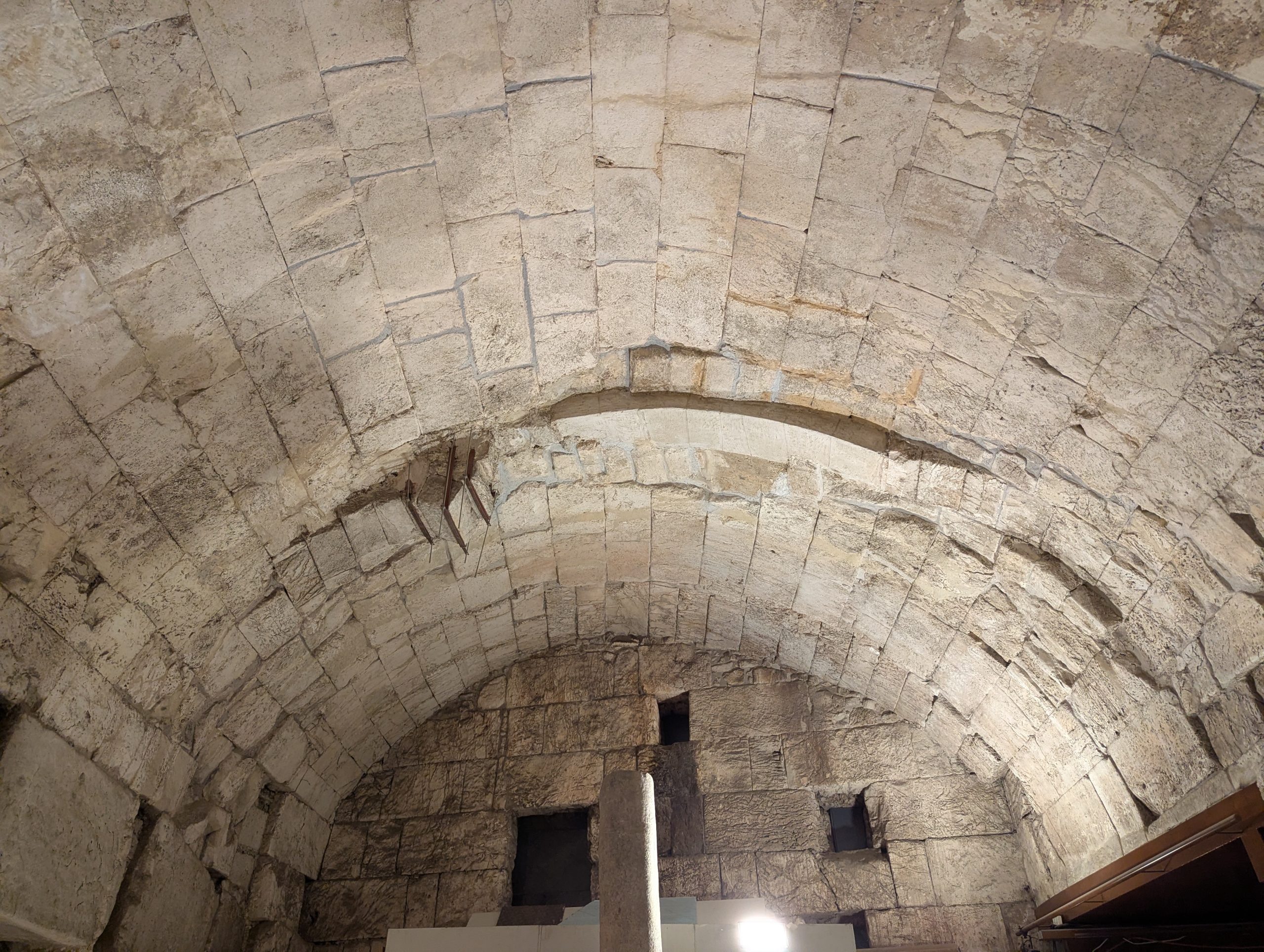
This tour, detailed below, goes one level deeper than the Great Stone Tour. It includes many vaulted rooms, some of them grand, others holding a series of mikvaot (Jewish ritual baths), as well as the remains of a Roman odeon (small theater) and an impressive section of the Western Wall.
VR Experiences
In addition to the two tunnel tours, there are three technology-centered experiences available at the Western Wall Heritage Center, as well as a visitors’ center. These include A Look into the Past (VR), the Journey to Jerusalem, and the Chains of Generations Center. These do not descend into the Kotel tunnels.
There is also an AR (augmented reality) hour-long guided tour for those who want or need to experience the tunnels remotely.
What You’ll See on the Great Bridge Tour
The tour begins with a quick video presentation, although I still found it somewhat difficult to visualize where I was standing relative to the Kotel. Below is an image made available publicly by the Western Wall Heritage Foundation that shows the upper level (Great Stone Tour route) but helps to clarify the direction of the tunnel.

Immediately after that, you go down a long flight of stairs and encounter the first of many mikvehs (Jewish ritual baths) that you’ll see on the tour (in the photo below, left). The mikvaot were used by Jews ascending the Temple Mount for ritual purification before entering the sacred grounds. After that, you proceed into a room with an impressive vaulted ceiling, which bore an aqueduct (below, right).


Next you pass through a closed-in version of what used to be a large space repurposed by many, including Herod, who added the decorative columns still visible. At one point it became a Roman bath, but with an important nod to Jewish sensibilities: no nymph statues.


Beyond this is a great hall, which, however, now includes an archaeological shaft and a sewage hole in its ceiling. On one wall is a double door, indicating a grand entrance, through which the tour proceeds.


Part of Wilson’s Arch is famously visible above ground, at the northern side of the Western Wall Plaza near the Kotel. It was named for Sir Charles Wilson by Sir Henry James, a Royal Engineer; Wilson was an officer in the British army and archaeologist, who was one of the first Western explorers of ancient Jerusalem, excavating there in 1864. However, the arch known as Wilson’s is part of a massive bridge complex bearing both a street and an aqueduct that serviced the Temple Mount in antiquity, during the late Second Temple period. Part of this complex, including numerous arches, can be seen within the tunnel.

Next is another complex of mikvaot (ritual baths). It includes one that is working and kosher—from the time of the Second Temple (in the photo below, right). (Our tour guide regaled us with stories of people on the tour who attempted to immerse in it; one immerses naked, so you can imagine this led to a number of colorful incidents and a combination lock on the gate.) The mikveh in the photo below, left has an unusual form, with stairs on all sides.


The tunnel then reaches the Western Wall. Just before the wall, remains are visible of an unfinished odeon, or small theater, built by the infamous Roman Legion X, who carved the legion’s abbreviation into the stones.


You then get to take in a stretch of the Western Wall that lay underground for centuries. This helped it to preserve the original rose gold hue of the local Jerusalem stone.


Towards the end of the tour, there is an interactive model that shows how the ground level changed so dramatically around the Temple Mount in and from antiquity. From that point, the Great Stone is visible, though from a distance.
The tour ends in the new Shaarei Teshuvah synagogue, one of two working shuls in the Kotel Tunnels. (The other, known as Rabbi Getz’s synagogue, is located at the point nearest to the Holy of Holies, by Warren’s Gate, on a site used for centuries. Warren’s Gate opened onto the Temple Mount and was discovered by yet another British archaeologist, Sir Charles Warren.)


Leave a Reply